Vittorio Iavazzo
Naples, 1991
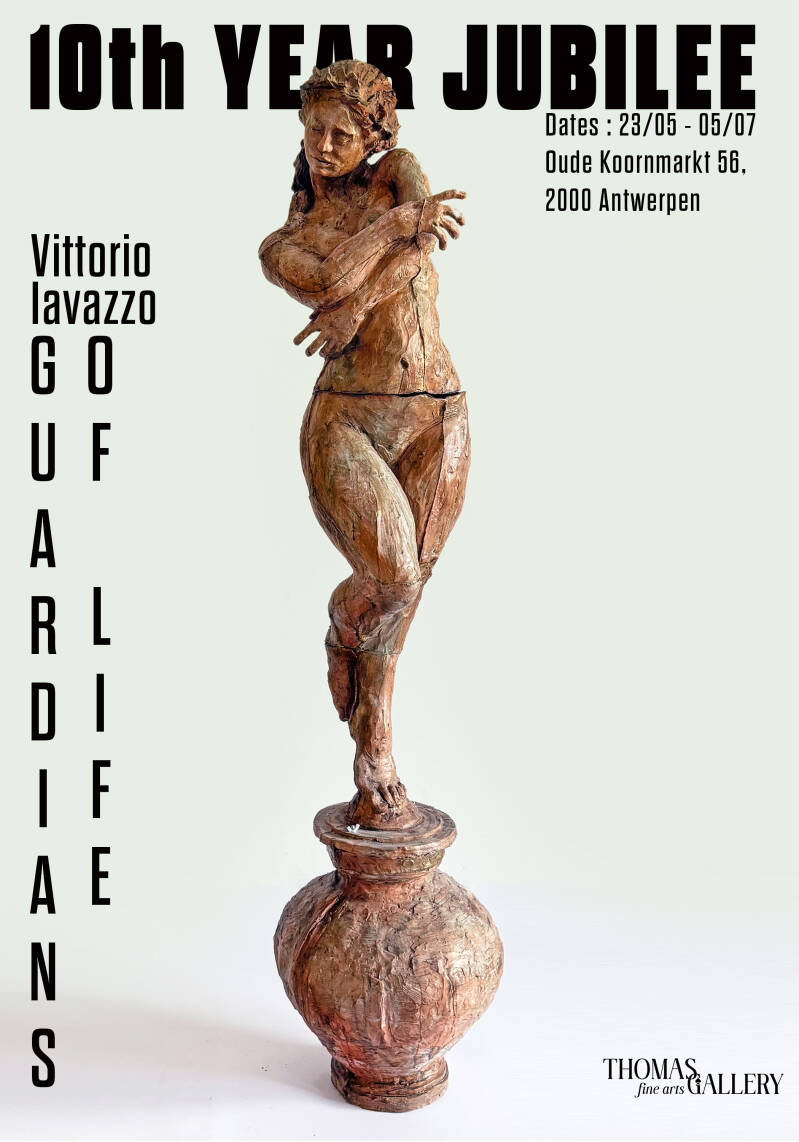
Vittorio Iavazzo, born in 1991 in Naples, developed a passion for drawing and the visual arts at an early age. In 2010 he began his studies at the Accademia di Belle Arti di Napoli, where he graduated in 2016 with a degree in graphic arts and illustration. Iavazzo’s work emerges from a profound dialogue with the classical artistic tradition and the rich cultural heritage of Italy. His sculptures explore the human condition,
embodying the delicate balance between the desire for freedom and the challenges of existence. Through a strongly mythological and symbolic universe, his work transcends rationality and seeks to capture the
essence of human emotions and experiences. Recurring themes in his visual language include the individual’s struggle against social constraints, the pursuit of inner freedom, and the
ongoing transformation of human existence. His figures often appear suspended in movement or caught in moments of fragile equilibrium, as if balancing between gravity and liberation. Iavazzo is known for his refined mastery of plastic and ductile materials, through which he gives his sculptures a remarkable sense of dynamism, elegance, and lightness. He primarily works with paper, plaster, and various polymers, often enriched with natural pigments, oxides, or even coffee. With these techniques he reinterprets, in a contemporary way, the tradition of papier-mâché, a craft deeply rooted in Neapolitan culture.

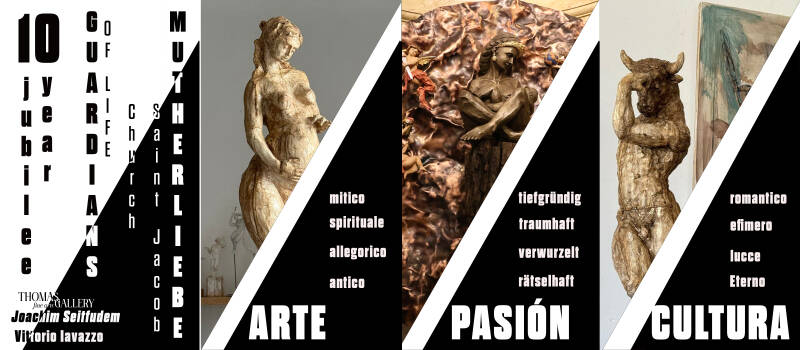

His sculptures are characterized by carefully studied anatomy contrasted with a more sketch-like treatment of certain details, creating a tension between precision and spontaneity. The figures—often depicted nude in their pure and natural form—evoke the great masters of the Renaissance, particularly Michelangelo, while maintaining a distinctly contemporary sensibility. Lines, threads, and fragile structural elements frequently play a crucial role in his compositions. They act as subtle forms of support and protection, generating a compelling interplay of solids and voids within the surrounding space. Despite their apparent fragility, the works radiate energy, movement, and an almost musical sense of lightness. Today, Vittorio Iavazzo’s work can be found in important international private collections and is represented by galleries across Europe, the United States, and Mexico.
Guardians Of Life

Within the cyclical circle of life, time moves through us like a silent art. It does not break or impose it sculpts.
With invisible patience,
it shapes what we have been into what we are
becoming.
This exhibition arises from an intimate and
universal reflection: life is not linear, but made of returns. It unfolds through passages, phases that
transform and regenerate birth, growth, change,
renewal.
We move through these shifts often without
noticing, crossing subtle and continuous
transformations.
What we have been settles into what we become, in a delicate balance between origin and change. Matter is never neutral: it absorbs, retains, and gives back. Paper, oxide, and coffee become the skin of time, living surfaces marked by signs, layers, and traces. Each work appears as a suspended presence, a fragment holding memory and transformation.
As in the creative process, every form begins with a fragile intuition, a mark, a drawing and moves through stages, pauses, and transformations, until it becomes body,
presence, sculpture.
So life shapes us: slowly,
inevitably, poetically.
The works invite a different sense of time: slower, deeper, more attentive. A space in which to pause and listen, where art and beauty open the heart to the essential emotions of existence.
The inspiration draws from ancient myth, yet speaks to the present: to the contemporary human
being, suspended between loss and rebirth, between speed and the search for meaning.